On an autumn afternoon in 1908, Ed Walsh threw 464 innings across a single season and still lost the pennant by a game. He won 40 times that year, spitting on the ball, hiding it in the shadow of his big frame, throwing until his arm ached and then throwing more. That was the deadball era. The ball was soft and dark, scuffed and stained, kept in play until it came apart at the seams. Runs were precious. Home runs were rare as snow in July. And the men who ruled that game did it from sixty feet, six inches away, with cunning and endurance and arms that seemed made of rope and iron.
The Ball That Made the Men
To understand the pitchers you must first understand the ball. It was used inning after inning, sometimes for an entire game, growing grayer and softer as the innings wore on. Pitchers were allowed to doctor it. They spit tobacco juice on it, cut it with belt buckles, rubbed it with dirt and licorice. A batter squinting at a mud-colored ball in the late-afternoon gloom had little chance of driving it four hundred feet, and little reason to try. Men choked up and slapped and bunted and ran.
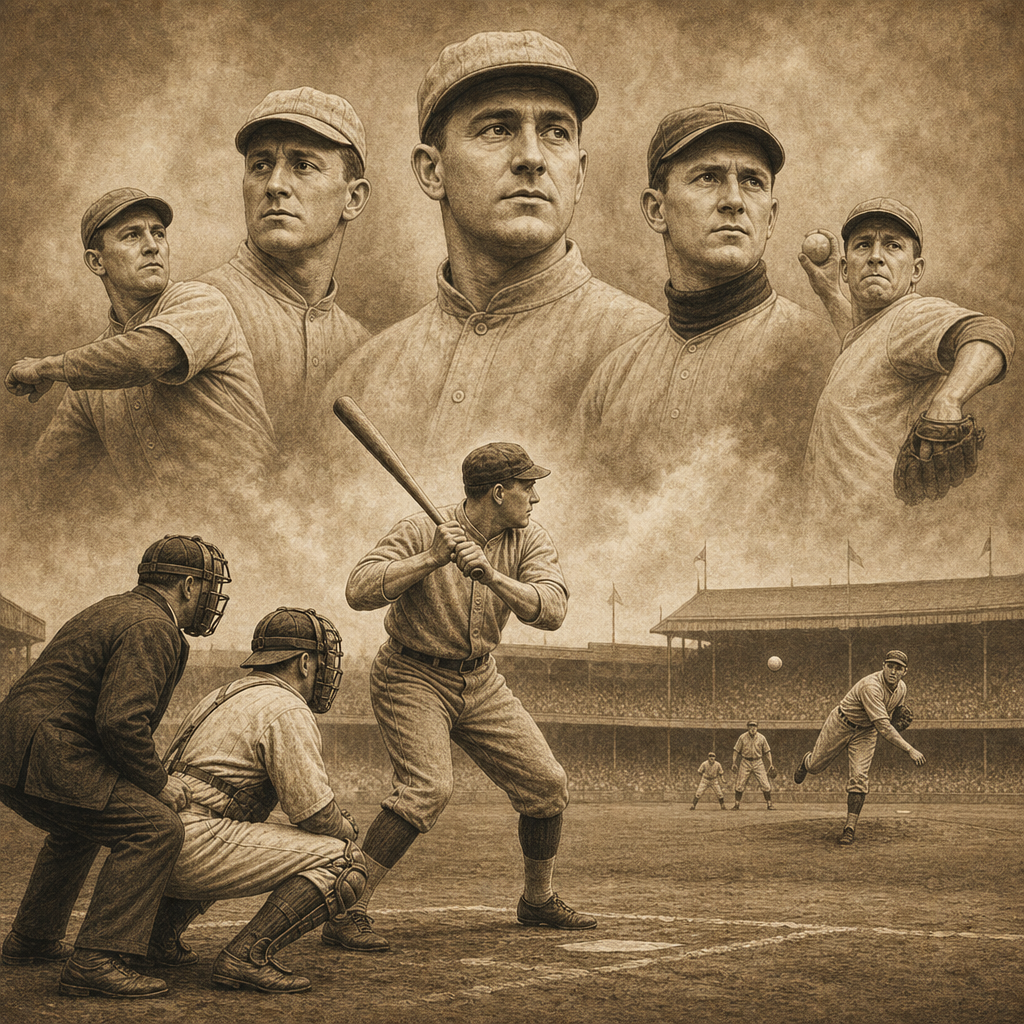
So the pitcher was king. He worked fast, threw complete games as a matter of course, and expected to finish what he started. Rotations were small and arms were worked hard. A staff ace might throw 350 innings and think nothing of it. The great ones threw more, and the best of them threw forever.
Walter Johnson and the Fastest Arm Alive
They called him the Big Train, and the name fit the sound. Walter Johnson came out of the Idaho desert with an easy sidearm motion and a fastball that hitters swore they never saw, only heard. Ty Cobb said the ball hissed when it passed. Johnson pitched for Washington teams that were mostly bad, and still he won 417 games, second only to Cy Young in the history of the sport.
In 1913 he went 36 and 7 with an earned run average of 1.14. He threw eleven shutouts. He was gentle off the field, feared on it, and so honest that hitters said he eased up when he had two strikes because he was afraid of killing a man. He never needed the trick pitches. He had the arm, and the arm was enough.
Mathewson, Brown, and the Art of the Craftsman
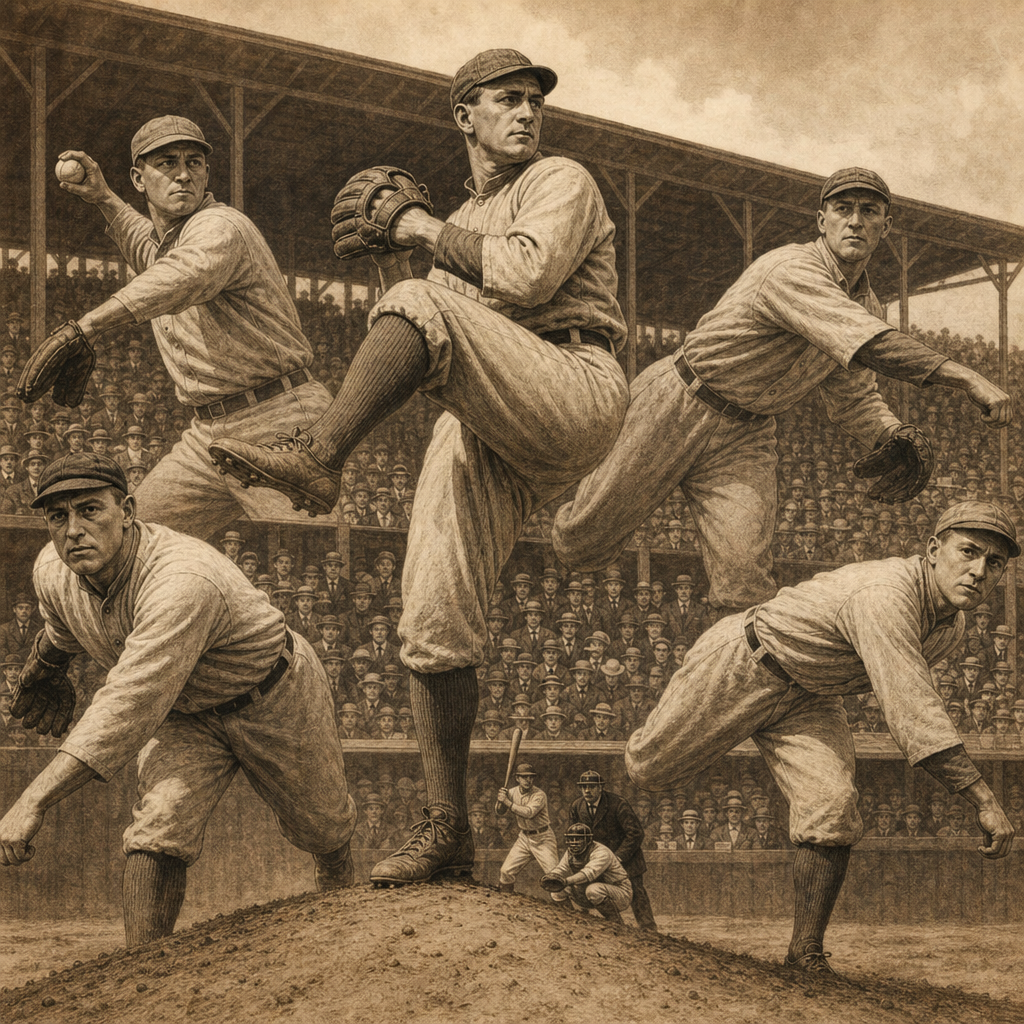
If Johnson was raw power, Christy Mathewson was intelligence. Tall, college-educated, handsome, he threw the fadeaway—what a later age would call the screwball—and he threw it where he pleased. In the 1905 World Series he pitched three shutouts in six days against the Athletics. Three. No earned runs across twenty-seven innings. It has never been equaled, and in the deadball era it made him something close to a god in New York.
His rival across town in Chicago was a man missing most of two fingers. Mordecai Brown had caught his right hand in a feed chopper as a farm boy, and the mangling left him gripping the ball in a way no one else could. His curve dropped off the table. They called him Three Finger, and he beat Mathewson time and again, holding his own against the greatest pitcher of the age with a hand that should have ended his career before it began.
Grover Cleveland Alexander joined them among the craftsmen. Pitching in a Philadelphia bandbox where the fences were close, he won 28 games as a rookie in 1911 and would win 30 or more three years running. He kept the ball low and worked the corners, and he did it in a park built to punish pitchers. He simply refused to be punished.
The Iron Men of the Rubber
Ed Walsh worked harder than any of them. The spitball was his weapon, and he threw it until his arm gave out, which it did, early and hard, after those monstrous seasons on the South Side of Chicago. His career ERA of 1.82 remains the lowest in the history of the game. He burned bright and brief, a man who spent everything he had and then had nothing left.
Cy Young bridged the eras. He had won his first games in the 1890s, before the mound was moved back, and he was still winning in 1908 at the age of forty-one, when he threw a no-hitter. He finished with 511 victories, a number no one will ever approach. He also lost more games than any pitcher in history, because he pitched more than any pitcher in history. That was the deadball way. You gave the ball to your best man and let him ride.
Then there were the ones the record books nearly forgot. Rube Waddell, the strikeout king, a wild soul who chased fire trucks and wrestled alligators and struck out more men than anyone of his day. Joe McGinnity, called Iron Man not only for his temperament but for the day he pitched and won both games of a doubleheader, which he did more than once. These were men built for a game that demanded everything.
The End of the Reign
The era closed in a rush. Around 1920 the game brought in cleaner balls, banned the spitball for most, and a young pitcher-turned-slugger named Babe Ruth began hitting the ball over fences at a rate no one had imagined. The offense the pitchers had smothered for twenty years came roaring back to life. The reign of the mound was over.
But for two decades those men owned the game. They pitched on two days rest and finished what they started and asked for the ball again. They were cunning and durable and, at their best, unhittable. They were the kings of the mound, and the game has not seen their like since.
Now it is your turn to run the club. Step into the general manager's chair, assemble your rotation of iron-armed aces, and see if you can bunt, steal, and shut out your way to a pennant in a free deadball-era baseball game.
Live it, don't just read it.
Take the GM's chair in 1910. Scout the sandlots and build a winner one stolen base at a time — free.
Open your front office