In 1910, a man named Fred Beck tied for the National League home run title with ten. Ten. A modern slugger might hit that many in a warm week of June. But this was the deadball era, a strange and beautiful stretch of baseball history when the home run was not a weapon but an accident, a thing that happened when a stout man caught a soft, waterlogged ball square and the wind was kind. To lead a league in home runs then was to be a curiosity, not a colossus. These were the unlikeliest sluggers who ever lived.
A Dead Ball and a Dirty One
To understand the home run kings of 1910, you must first understand the ball they hit. It was made with a rubber core, wound loose, and it did not travel. Worse, it stayed in play for innings on end. A single ball might be scuffed, spat upon, darkened with tobacco juice and infield dirt, and battered soft as a bruised apple before an umpire replaced it. Pitchers loaded it with saliva and paraffin and cut its seams with belt buckles. By the late innings a batter squinted at a gray smudge coming out of the twilight.
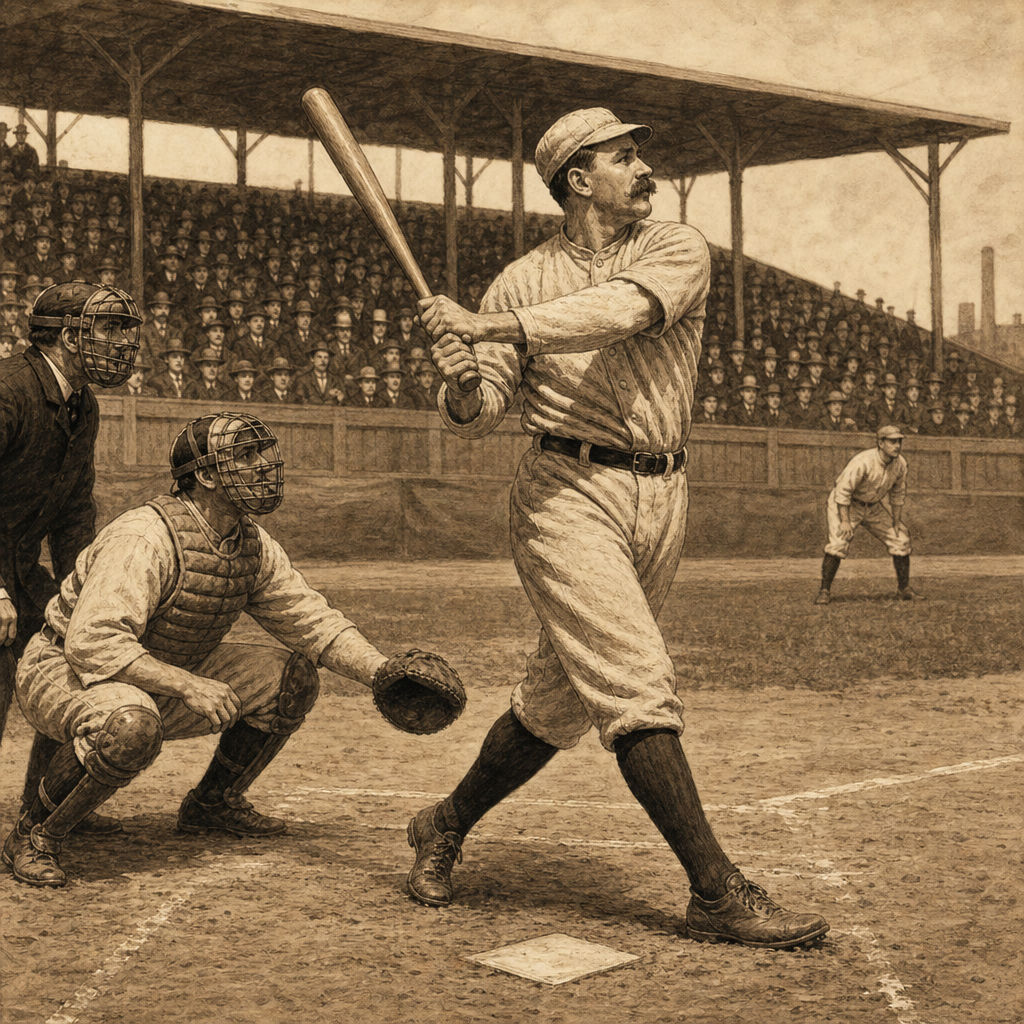
The parks did not help. Outfields ran on forever, four hundred and fifty feet to the deepest corners, with fences that were more rumor than reality. A ball hit hard rolled and rolled while runners circled the bases for an inside-the-park home run. The over-the-fence blast, the thing we now call a home run without thinking, was the rarest of birds. Men built their trade around the bunt, the stolen base, the hit-and-run. They played for one run and guarded it like gold.
The Quiet Leaders of 1910
So who ruled this modest kingdom? In the National League, Fred Beck of the Boston Doves and Frank Schulte of the Chicago Cubs shared the crown at ten apiece. Schulte was the more interesting figure, a wry outfielder who wrote poetry and loved fast horses. He would become, a year later, the first man to reach twenty-one home runs in the modern era, and in 1911 he won the Chalmers Award, an early Most Valuable Player prize that came with an automobile. But in 1910 he was simply one of two men who had found the fences ten times.
Over in the American League, Jake Stahl of the Boston Red Sox led with ten home runs of his own. Stahl was a big first baseman, college-educated, a man who would later manage Boston to a championship. Ten home runs made him the biggest power threat in his league that season, and nobody thought it strange. These totals were the norm, not the failure. A team might hit two dozen home runs across an entire summer and finish near the top of the standings.
Cobb, Wagner, and the Meaning of Power
The greatest hitters of the age were not home run men at all, and that tells you everything. Ty Cobb, the snarling genius of Detroit, won batting titles the way other men catch cold. He slashed line drives, bunted for hits, and terrorized basepaths with his spikes filed sharp. Cobb hit for the cycle of fear, not distance. In his entire twenty-four-year career he averaged fewer than five home runs a season. He did not care. Power, to Cobb, meant the power to make a defense crack.
Honus Wagner, the bow-legged Pittsburgh shortstop with hands like coal shovels, was much the same. He led the National League in batting eight times and could drive the ball to the alleys with tremendous force, yet his home run totals stayed low because the ball and the ballparks conspired against him. Wagner's genius showed in doubles and triples, in balls that split the outfielders and let his awkward, churning legs do the rest. The triple was the deadball era's true showcase of muscle. A man who hit twenty triples in a season was your slugger, your bruiser, your box-office draw.
This is the great lesson of 1910. Home runs did not measure a hitter's strength. They measured his luck, his ballpark, and the peculiar physics of a dead and filthy ball. The men who piled up ten of them were often not the game's best hitters at all, merely the ones who happened to loft a soft ball over a short corner a handful of times when the summer air allowed it.
Gavvy Cravath and the Coming Storm
If any man hinted at the future, it was Clifford "Gavvy" Cravath, though his moment came just after 1910. Cravath played for the Philadelphia Phillies and swung for the fences on purpose, a heresy in his day. He was helped enormously by the Baker Bowl, a cramped little park with a right-field wall so close it seemed you could touch it from the infield. Cravath learned to pull the ball into that friendly corner again and again, and from 1913 onward he led the National League in home runs six times in seven years, once reaching twenty-four. Men laughed at his approach. They said he was giving away outs. Then a young pitcher from Boston named Babe Ruth picked up a bat, and nobody laughed anymore.
The deadball era ended around 1920, killed by a livelier ball, cleaner baseballs mandated after a batter died from a pitch he never saw, and the spectacle of Ruth swatting home runs by the dozen. The quiet kings of 1910, with their ten-homer crowns, belonged to a vanished world. They were sluggers by the standards of their time and no other, honest craftsmen in an age that prized the bunt over the blast. We remember them now with a kind of wonder, these unlikely sluggers who ruled a game where the mightiest swing usually died in an outfielder's glove four hundred feet away.
Think you could build a winner in that scrappy, low-scoring world of dead balls and daring baserunners? Step into the general manager's chair and test your instincts against the deadball era yourself in this free baseball game.
Live it, don't just read it.
Take the GM's chair in 1910. Scout the sandlots and build a winner one stolen base at a time — free.
Open your front office